

Urban building projects are a different beast. You are not working on a wide-open industrial lot where you can park a 300-ton crawler crane and call it a day. You are working between occupied buildings, above active sidewalks, around power lines, traffic signals, and pedestrians who have no patience for a street closure that runs thirty minutes over schedule. The margin for error is thin, and the cost of choosing the wrong crane is not just financial. It can shut your project down.
This guide breaks down which construction cranes actually perform in tight city environments, what drives that decision beyond tonnage ratings, and what experienced contractors know that first-timers often learn the hard way.
Why Urban Job Sites Demand a Different Approach to Crane Selection
Most crane selection guides start with lift capacity. That is the right place to start on a greenfield site. On a city job site, you have to start somewhere else entirely: your footprint.
Before you even pull out a load chart, you need to answer a few questions. How much space does the crane need to set up its outriggers? What is the swing radius of the boom, and will it clear the building next door? Can the crane access the site at all given the street width and any overhead obstructions? And once it is set up, how long can you realistically hold that street closure before the city starts pushing back?
Those questions narrow your options fast. What looks like a crane problem is often a logistics and access problem that happens to involve a crane.
Luffing Jib Tower Cranes: Built for Congested Skylines
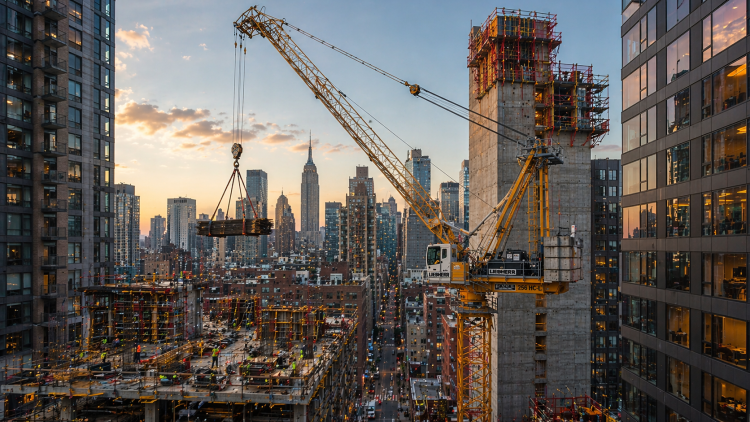
If you are building anything mid-rise or taller in a densely built area, the luffing jib tower crane is the crane that city contractors come back to repeatedly. The key difference from a standard hammerhead tower crane is in how the jib moves. Rather than a fixed horizontal jib that sweeps a wide, consistent arc, the luffing jib can raise and lower its jib angle. This means the operator can work in tight airspace without swinging the jib over an adjacent occupied building or into a neighboring crane’s radius.
In dense downtown corridors where two or more cranes are operating at the same time on neighboring projects, luffing jibs are not just preferred; they are often the only crane type that regulators and site planners will approve. The tighter rotation arc dramatically reduces the risk of crane collision and makes airspace management far more predictable.
The tradeoff is cost. Luffing jib cranes are more expensive to rent and more involved to erect than a standard hammerhead. If your project is long-duration and the site is genuinely constrained, the investment is justified. If you are doing a short lift or a single install, there are better options.
All-Terrain Mobile Cranes: The Urban Workhorse
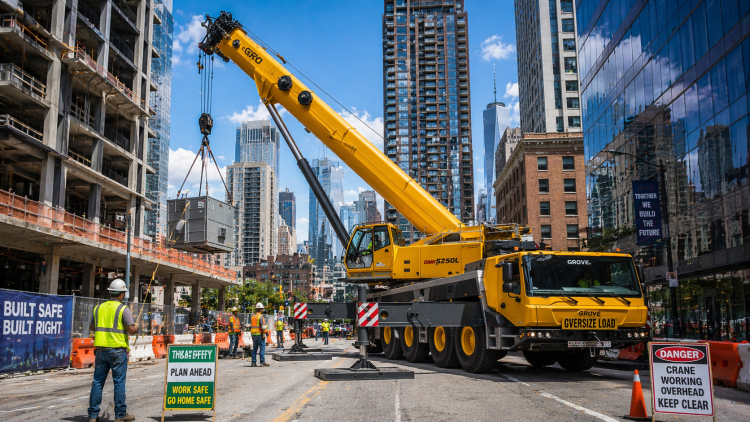
For contractors who need a crane that can get to the site under its own power, set up quickly, perform lifts, and get out without a full dismantling process, all-terrain cranes are hard to beat. They travel legally on public roads, handle varied ground conditions, and their telescopic booms give operators the ability to adjust reach and height on the fly without swapping out sections.
The speed advantage is significant in cities. Street closure permits are expensive and often come with strict time windows. A crane that takes four hours to set up is eating into productive lift time and burning permit hours. Telescopic boom all-terrain cranes set up fast, which is why they are a consistent choice for HVAC installs, rooftop equipment placements, and one-day or two-day lift operations that need to happen on a schedule the rest of the project depends on.
One thing to keep in mind when using an all-terrain crane in an urban setting: the machine may need to park across the street from the building, which immediately increases your horizontal reach requirement. As the boom extends outward, lifting capacity drops. Reviewing the load chart against both the height and the radius of your lift is non-negotiable. What the crane can handle at twenty feet of radius is a completely different number from what it can handle at sixty.
Self-Erecting Tower Cranes: Right-Sized for Mid-Scale Urban Work
Self-erecting cranes are gaining traction in urban construction for a good reason. They arrive on site essentially as a single unit, assemble themselves without requiring a separate assist crane, and have a compact ground footprint that works well in environments where staging space is limited.
They are not the right crane for heavy lifts or high-rise work. Their lifting capacity is lower than traditional tower cranes, and their reach is more limited. But for mid-rise residential projects, commercial renovations, and builds where a crane needs to be on site for several months handling consistent, repetitive material lifts, the self-erecting tower crane slots in efficiently without the setup cost or complexity of a full tower crane.
Remote control operation, which most modern self-erecting units support, also gives operators real advantages on tight sites where positioning relative to other structures and pedestrian zones requires fine precision.
Carry Deck and Compact Pick-and-Carry Cranes: When the Space Is the Problem
Sometimes the issue is not the lift itself. It is getting a crane into a position where it can even perform the lift. Carry deck cranes are small, four-wheeled machines that can rotate their boom a full 360 degrees and move materials around a confined site without outriggers. They are not built for heavy construction lifts, but for industrial maintenance, indoor installs, confined courtyards, and tight interior access, they solve problems that a larger crane cannot touch.
Similarly, knuckle boom cranes mounted on trucks use an articulated arm design to fold and reach into spaces where a straight boom would be physically impossible to maneuver. They are common in urban utility work, equipment delivery, and any lift where the access path has obstructions that a conventional boom would collide with.
Neither of these is a primary construction crane in the traditional sense, but knowing they exist prevents project managers from defaulting to a larger crane that requires a street closure and two hours of setup when a compact alternative would have handled the job in forty-five minutes.
The Variables That Matter More Than Crane Type
Picking the right category of crane is the first decision. Executing the lift well in a city environment depends on several other variables that are just as important.
Swing radius planning. OSHA requires that the full operational swing radius of a crane be clearly marked and that employees be protected from pinch and crush hazards in that zone. On an open site this is manageable. In a city, the crane’s swing radius may overlap with a sidewalk, a neighboring property, or another piece of equipment. This has to be planned before the crane shows up, not after.
Street closure coordination. Getting a crane into position on a city street often requires a partial or full lane closure, sometimes a block closure. The permit for that closure has a cost, a timeline, and in many jurisdictions, a requirement for traffic control personnel. Delays in the lift mean extended closures, which means additional cost and often friction with the municipality. A crane company that handles street closure coordination as part of their service takes a significant administrative burden off the contractor.
Ground bearing capacity. City streets are not engineered to support a 200-ton crane on outriggers. If the crane is setting up over a utility tunnel, a basement slab, or weak subsurface material, the ground support plan needs engineering review before the crane touches down. This step gets skipped sometimes on fast-moving projects and the consequences are severe.
Operator experience. A crane is only as precise as the person running it. In tight urban environments, operator skill is the variable that determines whether a lift goes smoothly or becomes a liability event. Certified operators with specific experience working in confined urban conditions make a measurable difference.
What the Right Crane Company Brings Beyond the Machine
The construction cranes that perform best on tight city job sites are not always the most powerful ones or the newest ones. They are the ones selected specifically for the site conditions, operated by people who understand urban lift dynamics, and supported by a company that handles the surrounding logistics so the contractor can focus on the work.
A reputable crane company should be doing more than dropping equipment off and leaving. They should be reviewing the lift plan, confirming load charts against actual site geometry, coordinating with local authorities on permits and street access, and having a qualified operator on site who communicates clearly with the rigging team throughout the lift.
When those pieces are in place, tight city job sites stop being a liability and start being just another project on the schedule.
Getting the Crane Right the First Time
Urban construction does not offer many second chances. A crane that cannot fit, a lift plan that did not account for the reach radius, or an operator who is not familiar with the conditions of a downtown site are problems that compound quickly. The cost of getting the crane decision wrong is not just the day rate. It is the schedule impact, the extended permit cost, and in the worst cases, the safety exposure that no project budget accounts for.
The contractors who consistently execute clean lifts in tight city environments share one common trait: they work with crane companies that treat the complexity of urban lifting as standard practice rather than an exception.
If you are planning a lift on a congested job site and need a team that knows how to work in those conditions, explore our crane rental services for HVAC, steel erection, solar, and general construction lifts, or call us directly at (877) 856-9686 to talk through your project before the crane truck ever leaves the yard.
